Pokemon EV Training Guide: Plan a Strong, Legal Spread
Pokemon EV training is the process of directing effort values into the stats that support a role. This guide explains the shared mechanics, the 510-point budget, practical item and battle methods, and a repeatable way to finish without overspending or training the wrong stat.
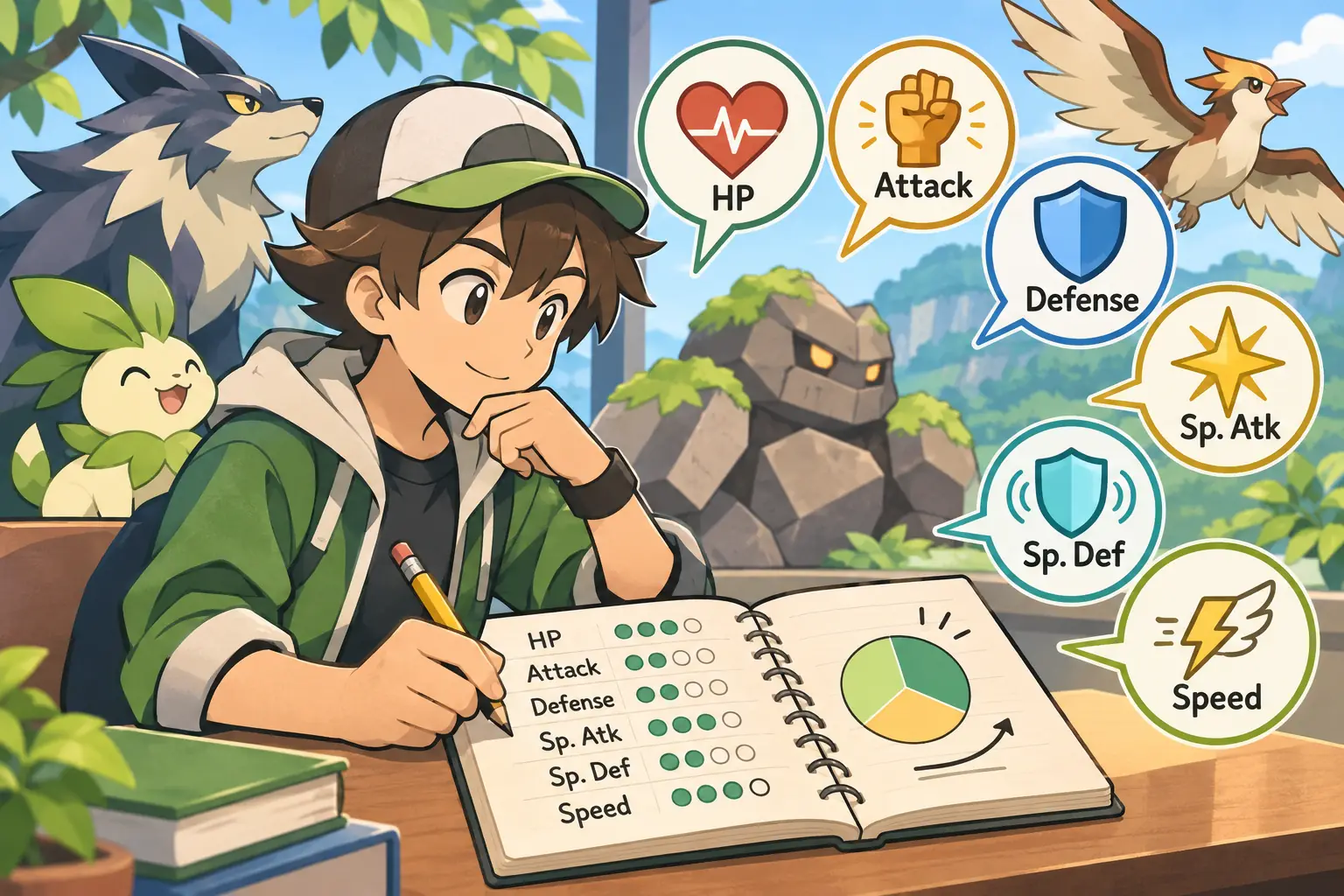
Editorial illustration: use a written spread and a verification step so each EV has a purpose.
Quick answer: how do you EV train a Pokemon?
Choose the role first, then assign a spread such as 252 Speed, 252 Attack, and 4 HP. Use vitamins, feathers, a Power item, or counted battles. Track gains, stop at the cap, and check the in-game graph or a trusted calculator.
Shops, locations, prices, and reset items depend on the game. The safe plan is universal: decide the target, use one method at a time, account for party-wide gains, and never treat experience as proof of EVs.
A Pokemon can hold up to 510 total EVs, with a modern per-stat ceiling of 252. Most competitive spreads use 252 + 252 + 4, leaving two points unused because EVs are counted in groups of four for stat points.
How Pokemon EVs work
EV stands for effort value. Battles, items, and game-specific activities add EVs to a stat. EVs are separate from base stats, IVs, levels, and nature modifiers, so the same species can be built as an attacker or support Pokemon.
A common rule of thumb is four EVs for roughly one stat point at level 100, with rounding at lower levels. That is why 252 is useful: it is the largest clean investment under the per-stat ceiling. At level 50, test the actual benchmark instead of judging a bar by eye.
Held items, vitamins, defeated targets, team-wide experience, and special training can all matter. Keep an untrained Pokemon away from activities that award surprise EVs.
EV limits and planning math
Think of EVs as a fixed budget. A 252 / 252 / 4 spread spends 508 EVs and leaves two points that cannot make another group of four. A 252 / 128 / 128 spread is legal when the middle investment answers a real survival or Speed benchmark.
Do not copy a spread only because a strong player uses it. Format, nature, moveset, item, ability, and expected opponents all matter. Story teams can use a simple two-stat plan; doubles often reward extra defensive points.
Different generations, remakes, spin-offs, and ROM hacks may change items or checks. Use this as a planning model, then verify the title.
| Planning question | Practical answer | Why it matters |
|---|---|---|
| Total budget | Up to 510 EVs | Prevents accidental over-training and keeps a spread legal. |
| One-stat ceiling | Up to 252 EVs | A single stat cannot absorb the whole budget. |
| Common offensive spread | 252 / 252 / 4 | Maximizes two priorities and uses the last useful group. |
| Level 50 display | Rounded and matchup-dependent | A leftover EV may not change the visible number. |
| Exact benchmark | Use a calculator or battle test | The right spread depends on the hit or Speed target you need. |
| Uncertain game rules | Verify the title first | Locations, item yields, and reset methods are not universal. |
EVs are gained one or more at a time, but the stat formula works in useful groups. Spending 508 EVs is not a mistake; the two remaining points simply cannot make another complete group of four.
Pokemon EV training methods
There is no single best method for every game. Choose the method that is easiest to count and easiest to undo. Items are fast when you have money, targeted battles are cheap when you know the right targets, and a mixed plan is often the most practical: use vitamins for the first large block, then feathers or battles to reach the exact number.
Power items are especially useful because they add EVs for a chosen stat while you battle. The bonus amount and name vary by generation, so use the current game's item description rather than importing a number from an older guide. Keep a note of whether the bonus is applied to every party member or only the active battler.
Vitamins usually add a fixed chunk to one stat and feathers add a smaller amount. Some modern titles allow vitamins past the old 100-EV stopping point, while older games may impose different rules. If the item is expensive, calculate the total before buying: an apparently quick method can cost more than a short battle route.
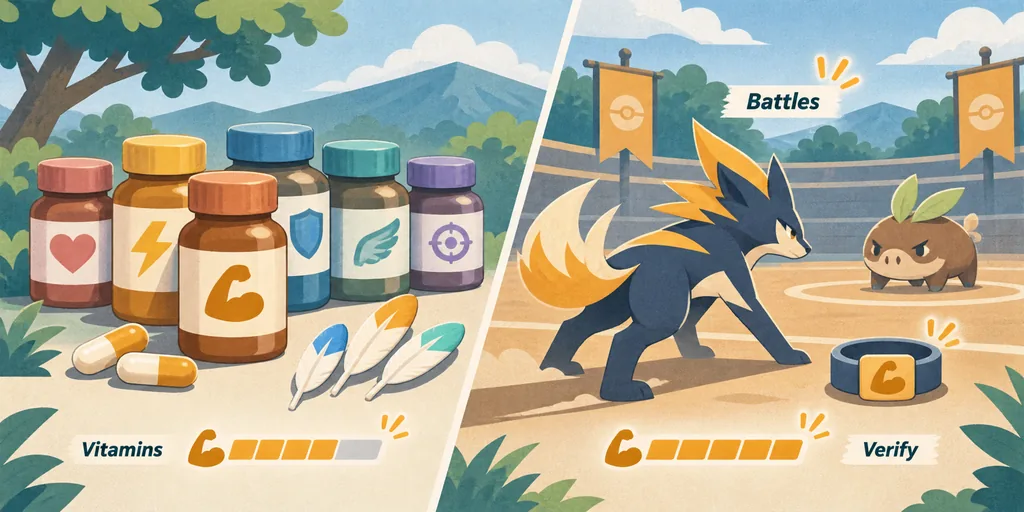
Use items for speed, battles for low-cost precision, and a final check for confidence.
Vitamins and feathers
Use them when the spread is known and you have enough currency. Apply a controlled batch, then use small items or battles for the remainder. Yields and purchase rules change by title.
Power item plus targeted battles
Equip the matching item, fight a repeatable target, and count knockouts. It costs less than a full vitamin batch but demands a clean route; avoid mixed targets.
Small drops
Wings, feathers, or similar items are ideal for the final 1-20 EVs and for correcting a spread that is four or eight points short.
Passive or special training
Poké Jobs, seminars, and minigames can award EVs in some games. They are convenient for several Pokemon, but verify the actual yield after the timer ends.
Mixed method
A practical plan is a large vitamin block, a few feathers, then counted battles. Record the yield before repeating it across a team.
A repeatable Pokemon EV training plan
Write the role and spread before opening a shop, then prepare the Pokemon so an accidental battle does not contaminate the plan. For a serious set, record nature, IV assumptions, ability, item, level, and format beside the EV numbers.
For a story run, choose one offensive stat and Speed, or one defensive stat and HP. Stop when the role is consistent; reset tools vary by game.
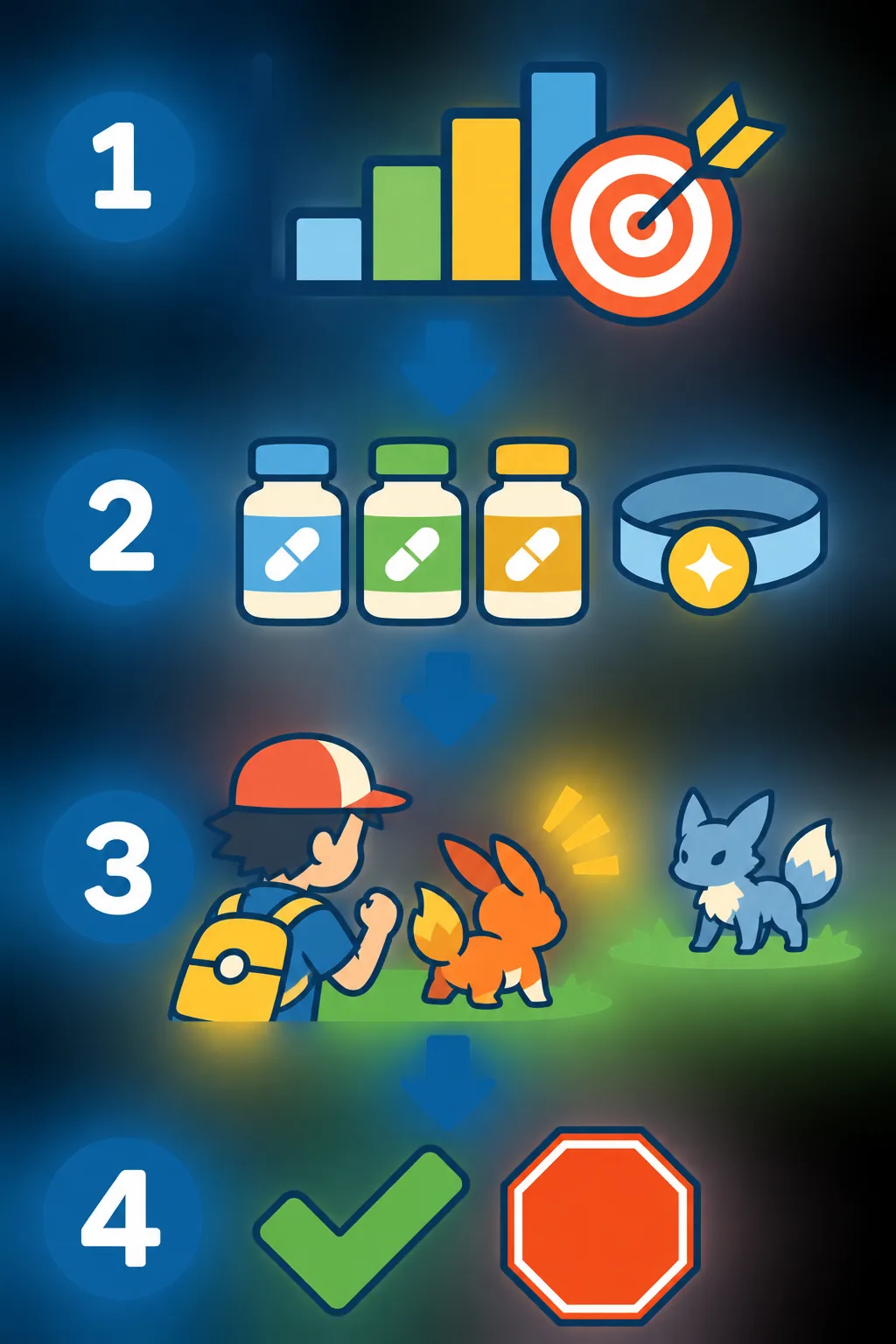
The four-step loop keeps EV gains intentional: choose, prepare, train, then verify and stop.
Choose a job and benchmark
Name the role and the reason: outspeed, survive, secure a knockout, or support a move.
Clean the starting point
Use the summary, a calculator, or a reset item. Unknown history does not mean zero EVs.
Prepare one method
Gather items and a clean route. Store unrelated party members when the game shares gains.
Train and record
Apply one batch and update the note. Count targets, not minutes, when battling.
Verify and archive
Check the graph or calculator, test the benchmark, and save the final spread with the set details.
How to verify or reset EVs
A full-looking graph may not show whether the points are in the right stats. Use the detailed summary, an in-game comment, or a reputable calculator. For level 50 formats, compare the displayed stat to the benchmark.
If the spread is wrong, stop battling first. Berries, mochi, or reset items vary by game; apply corrections carefully and recheck after each batch.
- Confirm the target stat order and the total budget.
- Check whether a nature, IV, ability, item, or temporary form affects the benchmark.
- Verify that the game's special training mode actually awards EVs.
- Save a copy of the final spread before using a reset item.
- Treat a visual graph as a clue, not a substitute for exact math.
Common EV training mistakes
Training before choosing a role
Randomly maxing a stat can leave a Pokemon with a spread that does not support its moves or nature. Write the job first, even for a casual run.
Counting experience instead of EVs
Leveling up does not tell you how many EVs were gained. Items, held Power bonuses, team-wide gains, and generation rules can change the total.
Mixing targets on one route
A route that awards HP, Attack, and Speed together is hard to audit. Use a clean target, then use a small correction item for the remainder.
Forgetting inactive party members
Some games award EVs to the whole party. Remove Pokemon that should stay clean or they may need a reset later.
Using an old location guide as current law
Locations and prices are version-specific. Keep the universal mechanics, but verify the current map and item yield.
Pokemon EV training FAQ
What are EVs in Pokemon?
EVs are effort values that add growth to a stat through battles, items, and training activities. They are separate from base stats, IVs, levels, and nature modifiers.
What is the maximum number of EVs?
The standard modern planning limit is 510 total EVs and 252 in one stat. Older games and special modes can differ.
Is 252 / 252 / 4 always best?
No. It is a useful two-stat default, but a benchmark may need HP, Defense, Special Defense, or a smaller split.
Do vitamins give EVs past 100?
Many modern games allow it up to the per-stat cap, while older titles used different restrictions. Check the current item behavior.
Does auto-battle give EVs?
It depends on the game. In Pokemon Scarlet and Violet, auto-battling gives experience but not EVs; verify other titles before grinding.
Can I remove wrong EVs?
Usually yes, with stat-reducing berries, mochi, or a reset feature. The item and strength differ by game, so recheck after correcting.
Reference notes
The guide uses shared main-series mechanics and keeps game-specific locations qualified. Use these references to confirm a generation's item yields, training spots, and competitive benchmarks.
- Serebii Effort Values — Overview of effort values, examples, and game-specific references.
- Marriland Scarlet and Violet EV Training — Current-generation examples for Power items, vitamins, party gains, and battle counts.
- VGC Guide EV Training — Competitive context for level 50 benchmarks, vitamins, feathers, and spreads.
- Smogon EVing Manual — Detailed background on EV math and the reason a spread changes a Pokemon's role.