Pokemon Weakness Chart: Every Type Matchup Explained
This Pokemon weakness chart gives you one place to check what every type hits for super-effective damage, what resists it, which attacks fail completely, and what each defending type is weak to. It also explains how dual types turn ordinary 2× matchups into 4× weaknesses or cancel them into neutral damage.

Editorial illustration: the chart below contains the actual matchup data; this image is not an official game screen.
How to read a Pokemon weakness chart
Start with the move's type when you are attacking. A Fire move is super effective against Grass, Ice, Bug, and Steel, but Fire, Water, Rock, and Dragon resist it. If you are checking defense, start with the Pokemon's own type instead: a pure Fire-type Pokemon is weak to Water, Ground, and Rock attacks.
Attack and defense are two views of the same matchup, but they answer different questions. The attack columns tell you whether a move is useful against a target. The defense columns tell you which moves threaten your Pokemon and which switches are safer. Keeping those directions separate prevents the most common chart-reading mistake.
The table uses the modern 18-type system. It is designed for the main series' standard type relationships, not as a promise that every spin, team, move, or species is legal in every game. Pokemon GO applies its own damage multipliers, while older generations contain a few historical differences.
Pokemon type effectiveness multipliers
In the main series, one matchup is usually represented by four practical outcomes. Dual typing multiplies both type relationships together, which is why the final result can be stronger or weaker than either type alone.
The attack type exploits one weakness on the defender.
The defender resists the attack type once.
A type immunity blocks the attack unless a game mechanic overrides it.
Two weaknesses stack to 4×; two resistances stack to 0.25×.
Complete Pokemon weakness chart for all 18 types
Read each row from left to right. The first three matchup columns describe that type as an attack. The final three describe a Pokemon of that type when it is defending. For example, Ground attacks are strong against Fire, Electric, Poison, Rock, and Steel; a Ground-type defender is weak to Water, Grass, and Ice and is immune to Electric attacks.
The table lists single-type relationships. For a dual-type Pokemon, check both defensive types and multiply the results. A resistance can cancel a weakness, two weaknesses can stack, and an immunity normally overrides the other multiplier.
| Type | Attacks: 2× | Attacks: 0.5× | Attacks: 0× | Defends: weak to | Defends: resists | Defends: immune to |
|---|---|---|---|---|---|---|
| Normal | — | Rock, Steel | Ghost | Fighting | — | Ghost |
| Fire | Grass, Ice, Bug, Steel | Fire, Water, Rock, Dragon | — | Water, Ground, Rock | Fire, Grass, Ice, Bug, Steel, Fairy | — |
| Water | Fire, Ground, Rock | Water, Grass, Dragon | — | Electric, Grass | Fire, Water, Ice, Steel | — |
| Electric | Water, Flying | Electric, Grass, Dragon | Ground | Ground | Electric, Flying, Steel | — |
| Grass | Water, Ground, Rock | Fire, Grass, Poison, Flying, Bug, Dragon, Steel | — | Fire, Ice, Poison, Flying, Bug | Water, Electric, Grass, Ground | — |
| Ice | Grass, Ground, Flying, Dragon | Fire, Water, Ice, Steel | — | Fire, Fighting, Rock, Steel | Ice | — |
| Fighting | Normal, Ice, Rock, Dark, Steel | Poison, Flying, Psychic, Bug, Fairy | Ghost | Flying, Psychic, Fairy | Bug, Rock, Dark | — |
| Poison | Grass, Fairy | Poison, Ground, Rock, Ghost | Steel | Ground, Psychic | Grass, Fighting, Poison, Bug, Fairy | — |
| Ground | Fire, Electric, Poison, Rock, Steel | Grass, Bug | Flying | Water, Grass, Ice | Poison, Rock | Electric |
| Flying | Grass, Fighting, Bug | Electric, Rock, Steel | — | Electric, Ice, Rock | Grass, Fighting, Bug | Ground |
| Psychic | Fighting, Poison | Psychic, Steel | Dark | Bug, Ghost, Dark | Fighting, Psychic | — |
| Bug | Grass, Psychic, Dark | Fire, Fighting, Poison, Flying, Ghost, Steel, Fairy | — | Fire, Flying, Rock | Grass, Fighting, Ground | — |
| Rock | Fire, Ice, Flying, Bug | Fighting, Ground, Steel | — | Water, Grass, Fighting, Ground, Steel | Normal, Fire, Poison, Flying | — |
| Ghost | Psychic, Ghost | Dark | Normal | Ghost, Dark | Poison, Bug | Normal, Fighting |
| Dragon | Dragon | Steel | Fairy | Ice, Dragon, Fairy | Fire, Water, Electric, Grass | — |
| Dark | Psychic, Ghost | Fighting, Dark, Fairy | — | Fighting, Bug, Fairy | Ghost, Dark | Psychic |
| Steel | Ice, Rock, Fairy | Fire, Water, Electric, Steel | — | Fire, Fighting, Ground | Normal, Grass, Ice, Flying, Psychic, Bug, Rock, Dragon, Steel, Fairy | Poison |
| Fairy | Fighting, Dragon, Dark | Fire, Poison, Steel | — | Poison, Steel | Fighting, Bug, Dark | Dragon |
Modern main-series type relationships. Always check the rules of the specific game or format when precision matters.
How dual-type Pokemon weaknesses are calculated
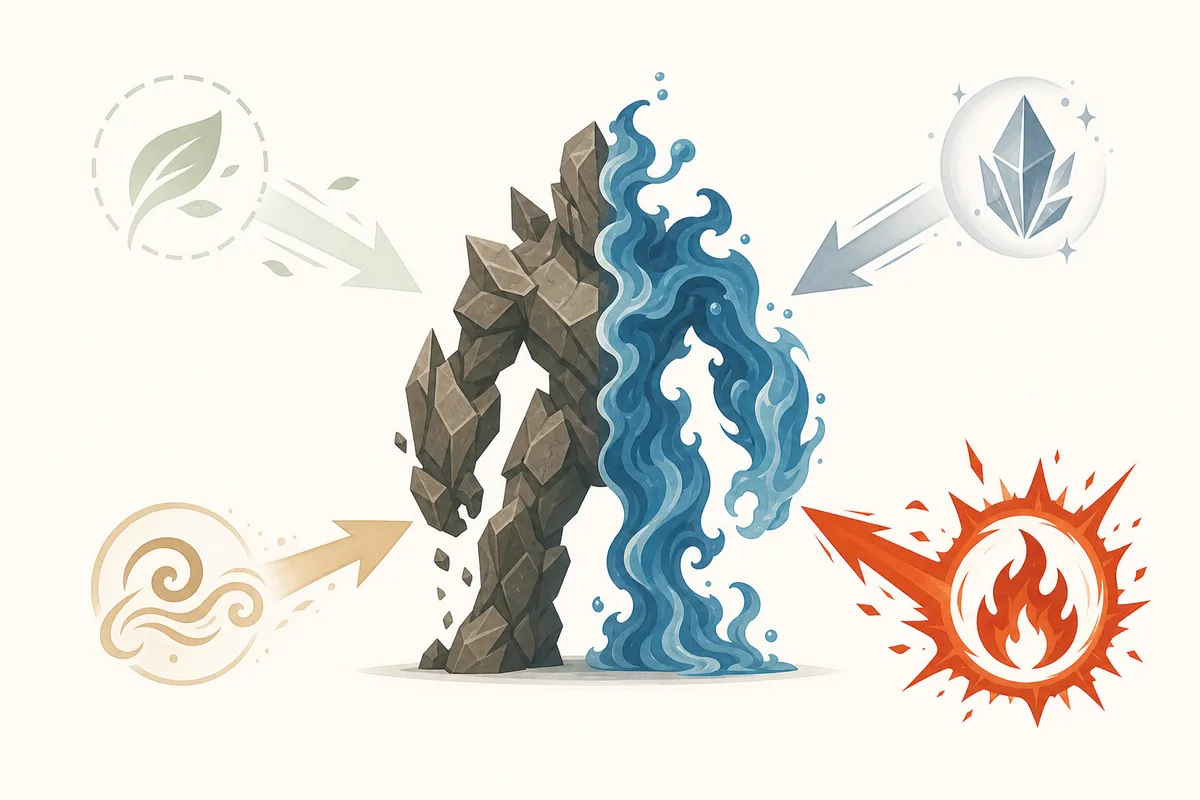
Concept illustration only: dual types combine two defensive matchups; the examples below show the actual arithmetic.
For defense, calculate the attack against both of the Pokemon's types and multiply the two values. This is easier than memorizing every dual combination. A Water/Flying Pokemon takes 2× from Electric because Water is weak to Electric and another 2× because Flying is also weak to Electric, producing 4× damage. The same Pokemon takes neutral damage from Grass because Water is weak to Grass but Flying resists Grass: 2 × 0.5 = 1.
Immunities deserve special attention. A Water/Ground Pokemon would normally combine Water's Electric weakness with Ground's Electric immunity. The immunity wins, so ordinary Electric-type attacks do no damage unless an ability, move, item, or format-specific mechanic changes the interaction.
Water / Flying vs Electric: 4×
Both types are weak to Electric, so the two 2× multipliers stack.
Fire / Steel vs Ground: 4×
Fire and Steel are each weak to Ground, creating a major shared weakness.
Water / Ground vs Electric: 0×
Ground's immunity blocks Electric even though Water is normally weak to it.
Grass / Poison vs Fighting: 0.25×
Grass and Poison both resist Fighting, so the attack is reduced twice.
How to use the type chart when building a team
A weakness chart is most useful as a decision tool, not a checklist that demands perfect coverage. Strong teams still need speed control, reliable damage, recovery, status management, and useful abilities. The chart helps you spot repeated weaknesses and missing answers before they become obvious in battle.
For a six-Pokemon team, pay extra attention when three or more members share the same common weakness and your remaining members cannot switch into that attack safely. Then look at offensive coverage: a team that cannot threaten Steel, Water, or other common defensive types may struggle even if its defensive chart looks balanced.
- Check the opponent's defending type — Use the attacking columns to choose a move that is super effective or at least neutral.
- Check both types — For dual-type targets, multiply the two matchups instead of reading only the first type.
- Review shared team weaknesses — Look for repeated 2× and 4× weaknesses across your planned team.
- Add safe switches — A resistance or immunity is often more valuable than merely having a super-effective move.
- Verify abilities and battle rules — Levitate, Mold Breaker-style effects, Terastallization, weather, items, and format rules can change the practical result.
Important game and generation differences
This page uses the modern chart introduced after Fairy became a type. Generation I had different details, including no Dark, Steel, or Fairy types, and Ghost-versus-Psychic behavior that did not match the later chart. Steel also resisted Ghost and Dark before Generation VI. If you are playing an older title or a ROM hack, verify which generation's chart the game uses.
Pokemon GO does not use the main series' exact numeric multipliers, even though the familiar ideas of weakness, resistance, and immunity are still recognizable. Competitive formats may also add mechanics that change a matchup without changing the underlying chart. Treat the table as the starting point, then apply the active game's abilities, moves, items, transformations, and rules.
If the chart and the battle screen seem to disagree, check the Pokemon's second type, ability, temporary type change, held item, and the game generation before assuming the chart is wrong.
Pokemon weakness chart FAQ
What is the easiest way to remember Pokemon weaknesses?
Learn the broad elemental relationships first, then use the chart for less intuitive matchups. Fire, Water, and Grass form a simple loop; Ground beating Electric and Fairy beating Dragon are other useful anchors. Team practice is more reliable than memorizing all 324 attack-defense pairs at once.
What are Fairy-type Pokemon weak to?
Fairy-type defenders are weak to Poison and Steel. Fairy attacks are strong against Fighting, Dragon, and Dark, but Fire, Poison, and Steel resist Fairy attacks.
Which dual type has the most weaknesses?
There is no single universally best answer without specifying the generation and whether abilities are included. Several dual types collect many 2× weaknesses, while others have fewer weaknesses but a dangerous 4× weakness. Use the two defensive rows and multiply them rather than relying on a fixed trivia answer.
Which Dragon-type Pokemon has the fewest weaknesses?
That depends on the second type, ability, form, and game rules. Pure Dragon is weak to Ice, Dragon, and Fairy. A second type can add, cancel, or double weaknesses, so check the exact Pokemon rather than applying one answer to every Dragon type.
Does Weakness Policy use the type chart?
Yes. In games where the item is available, Weakness Policy activates after its holder is hit by a super-effective move. Abilities, immunities, damage prevention, and format rules can still affect whether the hit qualifies.
Are Pokemon immunities always absolute?
Not always. The base chart gives Normal immunity to Ghost, Ground immunity to Electric, and similar relationships, but specific moves, abilities, items, or battle effects can bypass or alter an immunity.
Reference notes
The matchup table was checked against established Pokemon reference resources. External pages are provided for verification and species-specific follow-up.
- Official Pokemon Pokédex — Official species and type reference.
- Bulbapedia type effectiveness — Generation history and detailed mechanics.
- Pokemon Database type chart — Readable modern attack and defense chart.