Pokemon Breeding Guide: Build Better Eggs Step by Step
This Pokemon breeding guide explains how to choose compatible parents, plan inherited IVs and nature, collect eggs, and check a hatchling before you spend time training it. Game rules differ by generation, so every example is labeled instead of treated as universal.
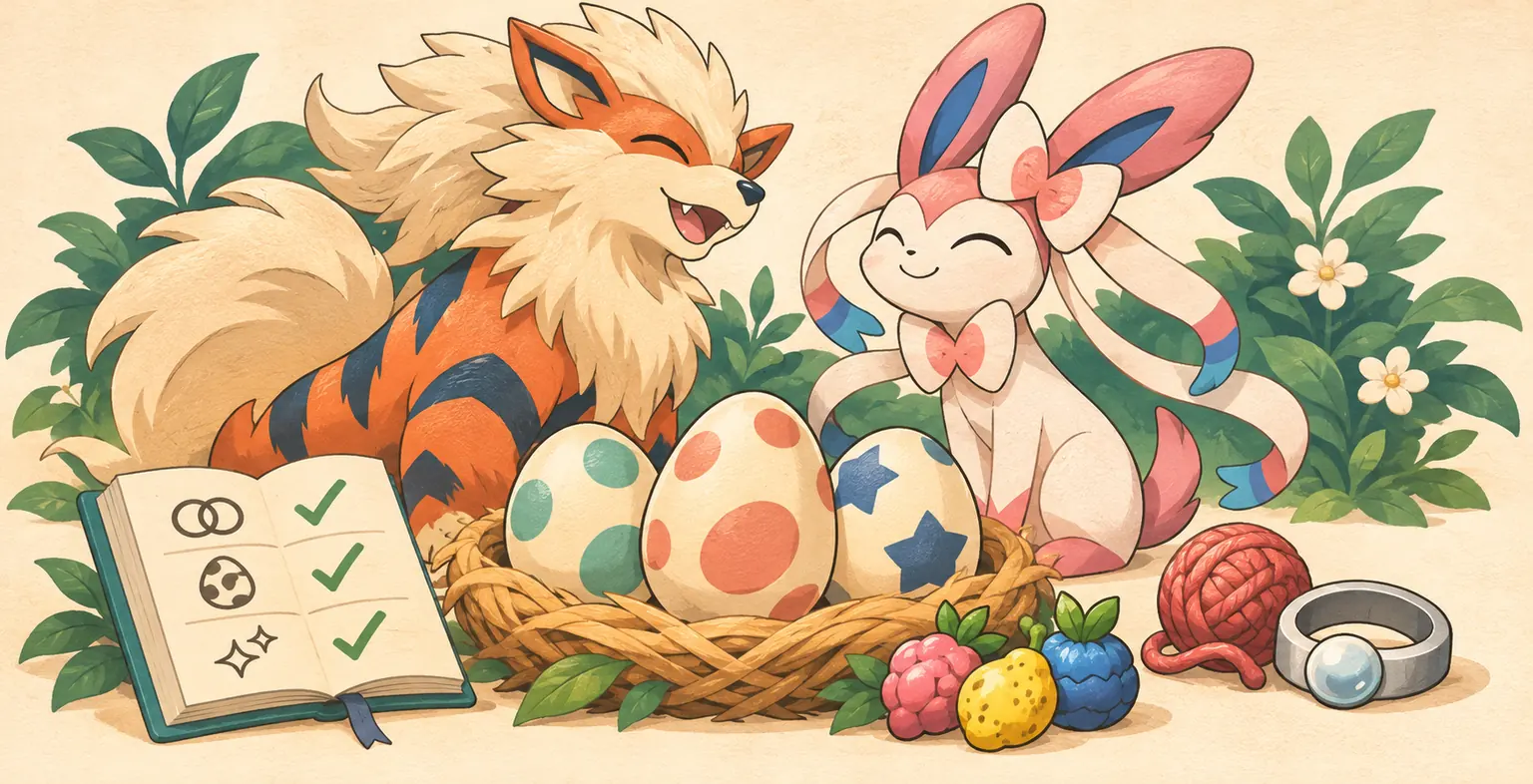
A breeding plan starts with compatible parents and a clear target.
Quick answer: what does Pokemon breeding solve?
Pokemon breeding is a way to create a new Pokemon with a planned species, ability, nature, moves, and sometimes better inherited IVs. The parent pair, held items, egg group, and game version all matter. A good Pokemon breeding guide therefore starts with the job you want the hatchling to do, not with a random trip to the nursery.
The shortest safe loop is: choose the target species and role, confirm that the parents can produce the right egg, equip the item that supports your goal, collect and hatch a small batch, then check the results. If the game uses a picnic or a day-care system, the buttons and timing differ, but the planning logic remains useful.
Write down the target nature, ability, useful egg moves, and the IVs that matter. Breeding can create a better starting point, but it does not replace EV training, level growth, or a final battle test.
Breeding basics: eggs, compatibility, and game differences
An egg appears only when the game considers the parents compatible. Compatibility normally depends on species, egg group, gender, and whether one parent is Ditto. Some titles use a day-care building, while newer games can generate eggs during a picnic. The interface is different, yet the question is the same: can these two parents produce the species you want?
The female or non-Ditto parent usually determines the species in the main series, while Ditto lets you breed many species that cannot pair with a normal opposite-gender partner. Baby Pokemon, special forms, and undiscovered egg groups can have restrictions. Check the target game's breeding table before you invest in held items or a long hatch cycle.
A Pokemon breeding guide should also separate universal ideas from version-specific numbers. Egg cycles, item names, ability inheritance, and the exact way eggs are offered can change. Treat a route recommendation as an example, confirm it in the current game, and record the version beside your breeding notes.
What can be inherited from the parents?
Breeding can preserve useful traits, but it is not a button that copies every parent detail. Species, nature, abilities, egg moves, ball inheritance, and IV selection each follow their own rules. The exact odds and item effects vary by generation, so use the table as a planning checklist rather than a promise about a particular title.
IVs are fixed values assigned when a Pokemon is created. A Destiny Knot-style item can make more parent IVs relevant in games that support it, while a Power item can target one stat. Nature can often be guided by an Everstone-style item. Hyper Training improves battle stats later in some games, but it does not turn the original IV record into a perfect inherited IV for every breeding purpose.
| Trait | Planning question | Typical aid | Important limit |
|---|---|---|---|
| Species | Will this pair produce the right species? | Correct parent or Ditto | Forms and baby species can have special rules. |
| Nature | Which nature matches the role? | Everstone-style item | The effect and exceptions depend on the game. |
| IVs | Which stats need strong values? | Destiny Knot or Power item | Inherited slots are selected by game rules, not chosen one by one. |
| Ability | Do I need a standard, hidden, or special ability? | Parent choice and ability odds | An ability item may not override every inheritance rule. |
| Egg moves | Does the hatchling need a move early? | Compatible parent or current transfer method | Move access differs between generations and species. |
| Shiny | Am I willing to hatch a large batch? | Masuda-style language pairing and charm | Shiny odds are game-specific and never guaranteed. |
IVs describe a Pokemon's starting potential; EVs are gained after creation through battles, items, or activities. Use the existing EV training guide after the hatchling passes your checks.
Breeding methods and items
The best method depends on whether you are making a competitive Pokemon, completing a living collection, hunting a shiny, or simply preparing a story team. Start with the least expensive method that can satisfy the target. A perfect six-IV plan is unnecessary if the Pokemon is for a casual run, while a tournament set may justify careful parent selection and repeated checks.
Use one method at a time and record what changed. If you swap the nature item, parent, language pairing, or target move halfway through a batch, it becomes difficult to tell which result came from which rule. The small note beside your party or box saves more time than another blind batch of eggs.
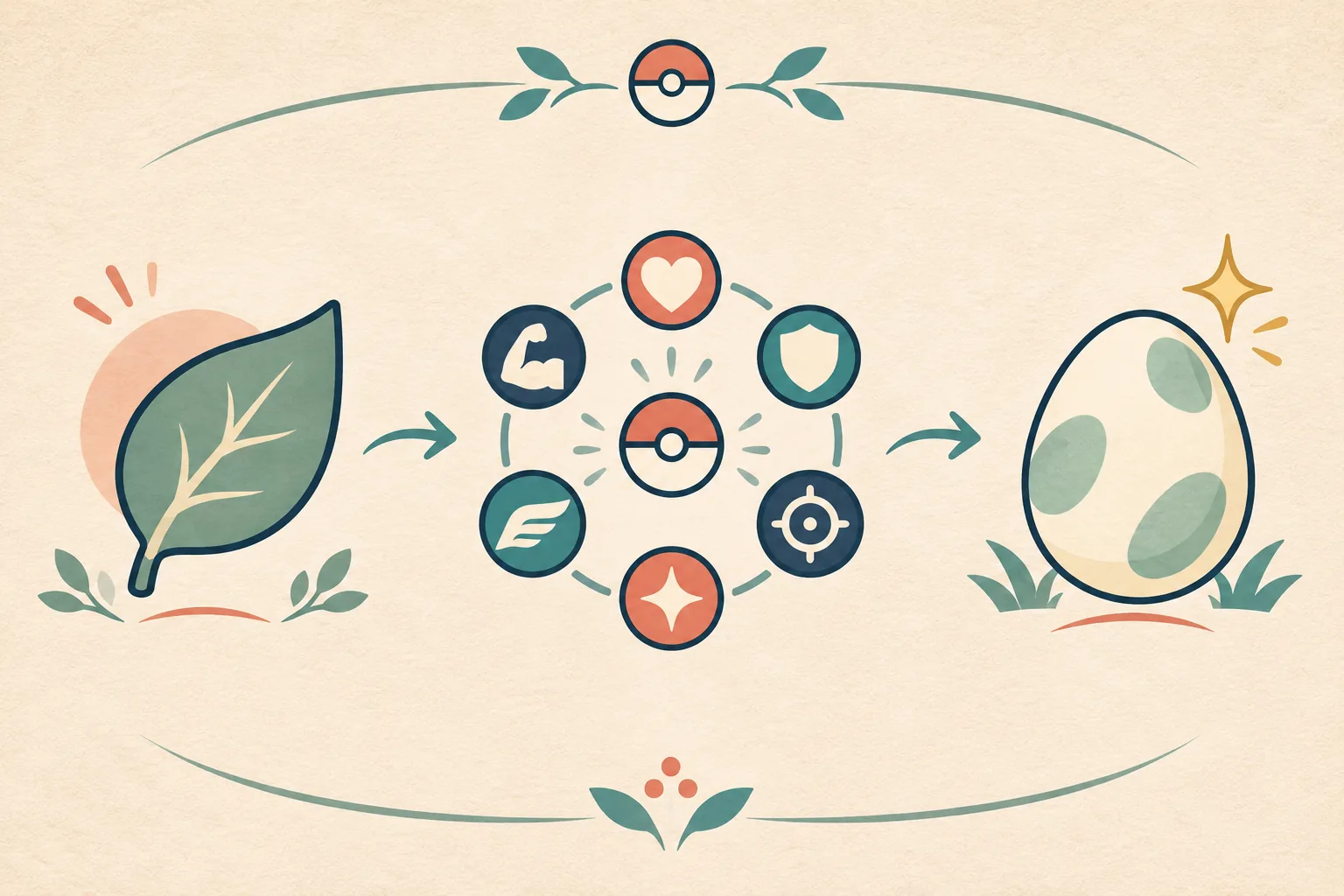
Choose the method that matches the goal before collecting a large batch.
Nature-first breeding
Give the nature-guiding item to the parent that already has the nature you want, when the current game supports that inheritance rule. This is useful when the rest of the build is flexible. If a nature can be changed later with a Mint-style feature, decide whether breeding it now is worth the extra setup.
IV-focused breeding
Begin with parents that already have useful IVs, then use the game's supported IV item to increase the number of inherited values. Check the Judge or an IV estimate after each group of hatches. Do not describe a 5-IV or 6-IV result as guaranteed unless the game's rules actually guarantee it.
Egg-move preparation
Identify the move and the legal parent before you start. Some games let a compatible parent pass a move directly, while newer transfer mechanics can change the setup. Confirm the move is available in the generation you are playing and that the hatchling can learn it.
Shiny breeding
The Masuda Method usually refers to pairing parents from different language games to improve shiny odds in supported titles. It still involves chance. A Shiny Charm or similar item may change the odds, but the item, language requirement, and odds must be checked for the current game.
Casual batch
For a story or challenge run, use compatible parents, a preferred nature if convenient, and a short hatch batch. Stop when the result fits the role. Overbuilding a perfect spread can delay the fun without improving the part of the game you actually plan to play.
A repeatable Pokemon breeding plan
A repeatable plan prevents the most common breeding mistake: collecting dozens of eggs before deciding what success means. Keep the target species, nature, ability, IV priorities, move requirements, and game version in one note. If any item is uncertain, mark it as a check rather than silently assuming a rule from another generation.
Use a small test batch first. Hatch enough eggs to confirm that the pair produces the expected species and that the item has the intended effect. Once the result makes sense, continue the batch, move the best parent into the next round, and stop when the role-specific benchmark is met.
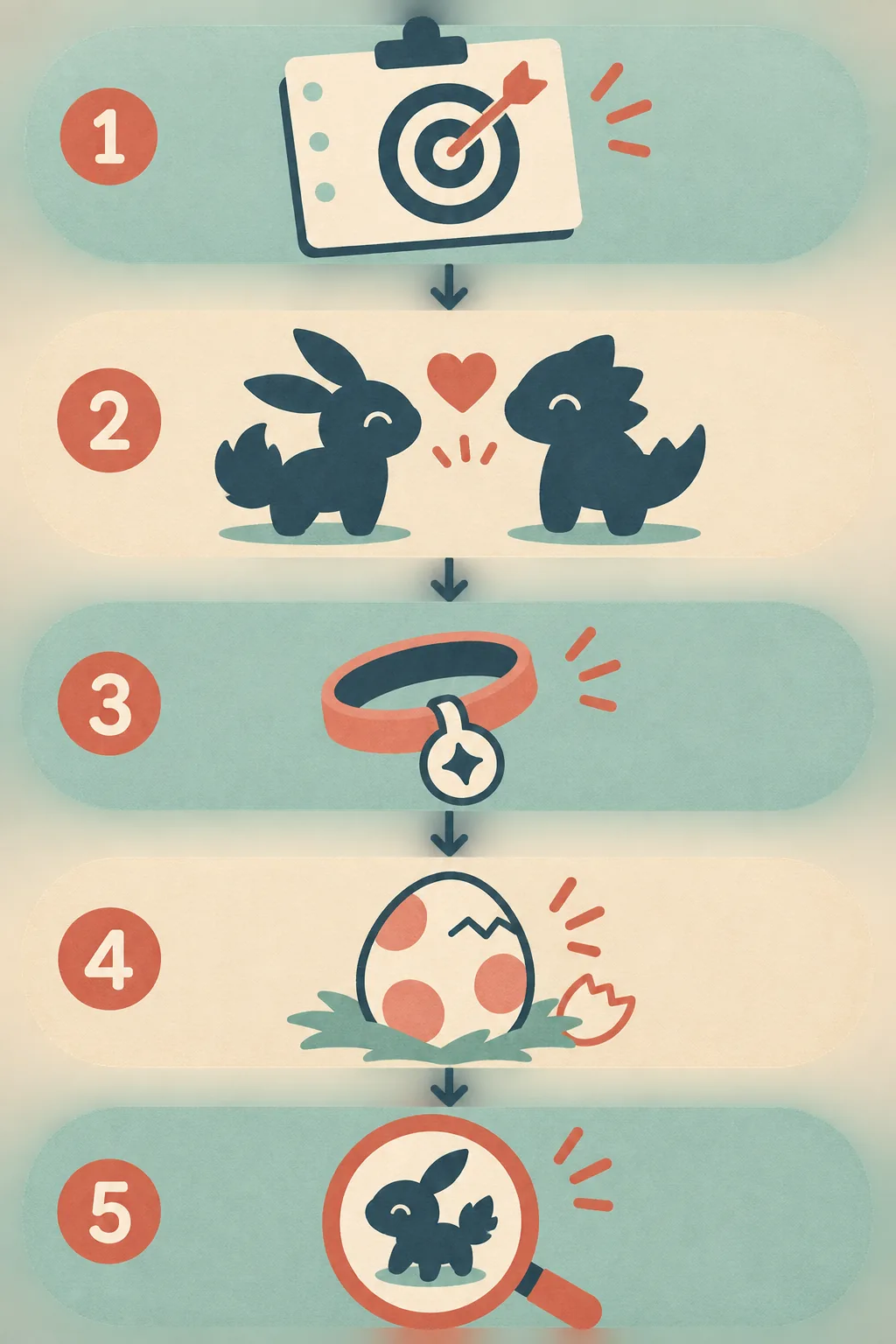
The repeatable loop is choose, equip, collect, hatch, and verify.
Define the role
Write whether the Pokemon is a physical attacker, special attacker, wall, speed control option, story partner, or shiny collection target. This tells you which nature and IVs matter.
Check the parents
Confirm species, egg group, gender or Ditto use, ability, nature, language, and the legal egg move. Remove a parent that cannot produce the intended result before you start a long cycle.
Equip one clear setup
Give the nature or IV item to the correct parent, carry the intended party members, and choose a route or picnic routine that makes egg collection easy. Keep a spare box or storage space ready.
Collect and hatch a test batch
Generate a small group, hatch it with the game's normal method, and check species, nature, ability, move list, and visible IV clues. Record the result instead of relying on memory.
Select, repeat, and stop
Use the best hatchling as the next parent when the game allows it, then repeat only the part that is still missing. Stop when the Pokemon meets the role benchmark and save the final notes.
Check the hatchling before training it
A successful hatch is more than seeing the right species. Open the summary and check the nature, ability, move list, and any form or ball detail that matters to your plan. In games with a Judge feature, inspect the IV phrases after the feature is unlocked. In other games, use a reputable calculator with the correct level, nature, EVs, and item assumptions.
Do not start EV training until the basic identity is correct. If the ability or move is wrong, it is usually cheaper to place the hatchling in storage and continue the batch. When the result is correct, link it to the EV training guide and record the intended spread before gaining accidental EVs.
- Confirm species, form, gender, and the generation-specific egg result.
- Check the nature and whether a Mint-style effect changes battle stats later.
- Check standard or hidden ability odds before treating a result as a failure.
- Review egg moves and current move-transfer rules.
- Use the Judge or calculator with accurate level, EV, and nature inputs.
- Write the selected IV targets and EV plan before battling.
Common Pokemon breeding mistakes
Assuming every game uses the same nursery
Day-care buildings, picnics, egg collection prompts, and hatch bonuses differ. Confirm the current game's interface and timing instead of copying an old route word for word.
Starting with the wrong egg group
Two compatible-looking Pokemon may not produce an egg. Check the egg group or use Ditto where appropriate, then test one egg before assembling a full setup.
Treating a perfect IV goal as mandatory
A story Pokemon and a level-50 competitive set have different needs. Define a benchmark, because extra rounds of breeding have a real time cost.
Forgetting the ability or egg move
A good nature and IV spread cannot repair an ability or move that the set needs. Put these checks beside the target species before the first batch.
Training before verification
Battles can add EVs and make later calculations harder. Check the hatchling first, then use the EV guide and keep the intended spread with the set.
Promising shiny odds as a result
Language pairing and charm effects improve odds only in supported games. Breeding still uses chance, so write a realistic stopping plan and never guarantee a shiny hatch.
Pokemon breeding guide FAQ
What is the fastest way to start Pokemon breeding?
Choose the target species and role, confirm compatible parents or Ditto, equip the one item that supports your immediate goal, and hatch a small test batch. Verify the result before scaling up.
Can breeding guarantee perfect IVs?
Usually no. IV items can increase the number of inherited values in supported games, but the exact odds and caps are game-specific. Check each hatch and avoid calling a result guaranteed without a rule that proves it.
Do EVs pass through breeding?
No. EVs are earned after the Pokemon exists. Parents can influence other traits, but the hatchling needs its own EV plan after you verify it.
Which parent passes the nature?
A nature-guiding item such as an Everstone-style item can steer inheritance in many modern games. The holder and exceptions vary, so confirm the current game's rule before starting a large batch.
What is the Masuda Method?
It is a commonly used shiny-breeding method that pairs compatible parents from different language games in titles that support the bonus. It improves odds but never guarantees a shiny result.
Can I breed a hidden ability?
Some games allow a parent with a hidden ability to pass it at a game-specific chance, while other pairings cannot pass it. Check the species and generation rule instead of assuming any parent can transfer it.
Why did I receive the wrong species?
Species is normally tied to the non-Ditto parent, but baby forms, regional forms, incense rules, and special cases can change the outcome. Recheck the current species and form table.
Should I use a calculator after hatching?
Yes when exact IVs matter. Use the Judge feature or a reputable calculator with the correct level, nature, EVs, and item assumptions, then save the result before training.
Reference notes
The guide separates stable planning ideas from version-specific rules. Use these references to verify IV terminology, breeding inheritance, and the current game's details before a long batch.
- Smogon Breeding Guide Part I — Background on IVs, natures, discovering values, and egg inheritance.
- Serebii Individual Values — IV explanations, examples, and links to generation-specific calculators.
- DittoBase IV Guide — Current Scarlet and Violet examples for Judge, Hyper Training, and breeding.
- VGC Guide IV Breeding — Competitive context for parent selection and inherited IV goals.