Pokemon Wonderlocke Rules: Setup, Trades, and Clauses
Pokemon Wonderlocke rules add a random trade to a Nuzlocke-style run: catch the first eligible encounter in each area, then trade it for a mystery partner. This rule sheet settles duplicates, fainting, gifts, and level limits before you begin.
Quick Answer: A Simple Wonderlocke Rule Set
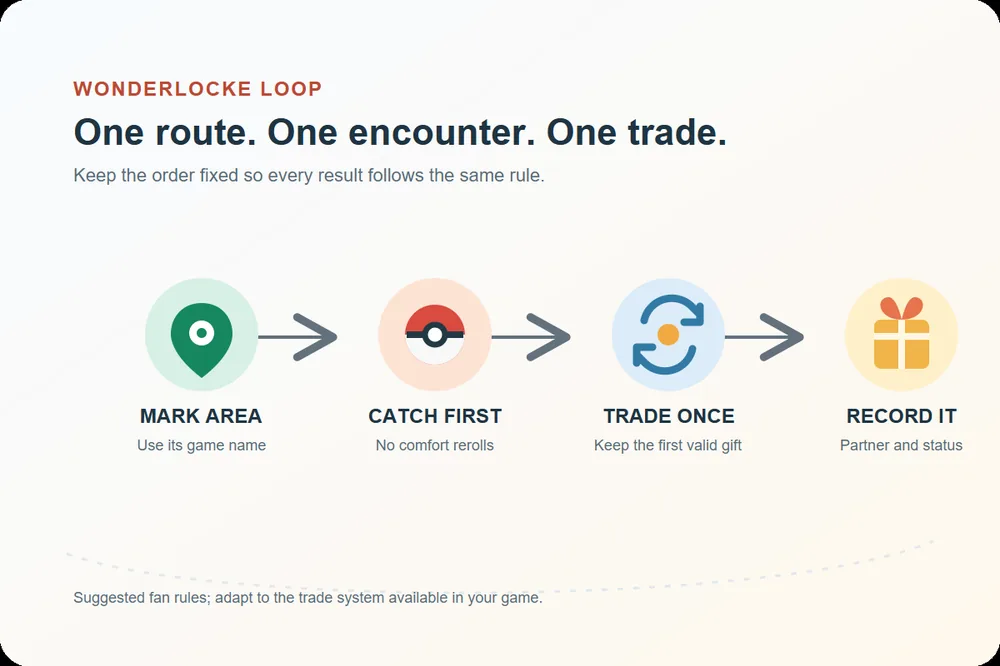
For a straightforward run, use one encounter per named area, catch the first eligible wild Pokemon, and complete one random trade before using it. The received Pokemon becomes that area's encounter. If it faints, retire it; if it is a duplicate, follow your preselected clause.
Wonderlocke has no single official rulebook. Community versions disagree about starters, gifts, shiny Pokemon, duplicate results, and whether a faint ends the whole run. The rules below are a consistent suggested template. Change a clause if your game requires it, but write the change down before it affects a result.

Pokemon Wonderlocke Rules at a Glance
This recommended baseline is designed to be easy to track in an ordinary playthrough. It is a fan-made starting point, so agree on any changes before the first encounter.
| Situation | Suggested rule | Why it helps |
|---|---|---|
| Route encounter | One first eligible wild encounter | Prevents repeated fishing for a preferred trade |
| After a catch | Trade once before using it | Makes the mystery trade part of the run |
| Duplicate result | Allow one replacement trade, then keep the result | Avoids unlimited rerolls |
| Fainted Pokemon | Retire it from the party and box | Keeps the Nuzlocke loss rule clear |
| Starter | Keep it as the run's one exception | Lets the opening stay playable |
| Gift or static Pokemon | Set a separate rule before claiming it | Different games handle gifts differently |
What Are Pokemon Wonderlocke Rules?
A Wonderlocke is a fan-made Pokemon challenge that combines Nuzlocke-style encounter limits with random trading. In a common version, you catch the first eligible Pokemon from an area and send it through the game's random trade feature. You keep the stranger's return, so the team you use is shaped by both the route and chance.
The trade is the defining twist; the rest is a set of choices. Players may add fainting, nickname, healing, or gift rules. Community versions differ, so explain yours to friends or viewers instead of calling one set universal.
Choose the Core Rules Before You Start
These Pokemon Wonderlocke rules are a consistent baseline, not a universal format. Use the same meaning of an area throughout the run. A route, town, or cave floor can count separately when the game displays a distinct name. Keep using the map label after an inconvenient encounter.
A fair baseline is one encounter for each eligible location and one random trade for each captured encounter. Your caught Pokemon is only a temporary carrier, not a chance to inspect several trade results. If the game's trade system is unavailable at that moment, keep the catch unused and complete the trade at the next safe opportunity.
- A failed capture still uses that location's encounter.
- A duplicate species clause applies only if you announce it before the run.
- A valid random result is accepted; do not keep trading for a stronger pick.
Set Up a Wonderlocke in Five Steps
Choose a game with a usable random trade feature and write the encounter limit, trade order, fainting rule, level cap, and exceptions where everyone can see them. A short note is enough.
- Choose whether the starter is kept, traded, or treated as an exception; the suggested beginner option is to keep it.
- Define location names and decide whether separate rooms count as separate areas.
- Pick a duplicate policy and a limit for replacement trades before seeing any results.
- Set a level cap if you want received Pokemon to stay within the game's obedience rules or a badge-based challenge.
- Create a route log with caught species, traded-away species, received partner, and status.
First Encounters, Captures, and Route Names
At an eligible location, catch the first wild Pokemon you encounter. If it runs away, faints, or escapes, mark the encounter used. This keeps the route rule meaningful when the result is inconvenient.
Decide how to handle areas with several encounter methods. One simple option is to use the first wild encounter of any kind. A more controlled variant lets you choose a method such as grass or fishing, but that method must be chosen before the first encounter. Do not switch methods after seeing an unwanted species.
- Choose whether duplicate wild encounters can be skipped; if yes, set a small retry limit.
- For caves or multi-floor areas, use the game's displayed location name consistently.
- If a route has no usable wild encounter, mark it unavailable rather than claiming an unrelated gift.
How the Random Trade Rule Works
After the catch, make one random trade as soon as it is safe to leave the battle. Trade away the caught Pokemon and accept the first valid partner returned by the game. Do not check its stats, moves, evolution, or competitive strength before deciding whether to keep it; the uncertainty is the point of the rule.
If a connection or game restriction blocks the trade, keep the catch out of battle and try later. If random trading is unavailable for the whole game, choose another challenge instead of calling it a Wonderlocke.
- Record the route and the received partner immediately.
- Use at most one replacement trade when your preselected duplicate clause allows it.
- Accept a valid but inconvenient result instead of fishing for another trade.
Fainting, Party Limits, and Battle Rules
For a Nuzlocke-style baseline, retire a traded Pokemon permanently when it faints. Box or release it, and do not bring it back. Decide in advance whether a full-party wipe ends the run or lets boxed survivors rebuild the team.
Keep the ordinary party limit of six unless your chosen game or a separate challenge rule says otherwise. Received Pokemon may arrive at levels or with abilities that make the run easier or harder. Set a level cap, item rule, or battle-style restriction only if you can apply it consistently, and write it beside the encounter rules.
- Optional: nickname each received Pokemon to make the run easier to follow.
- Optional: limit healing items or battle items for a harder run.
- Do not treat a forced story battle loss as a normal faint unless your rules say it counts.
Starters, Gifts, Shinies, and Other Exceptions
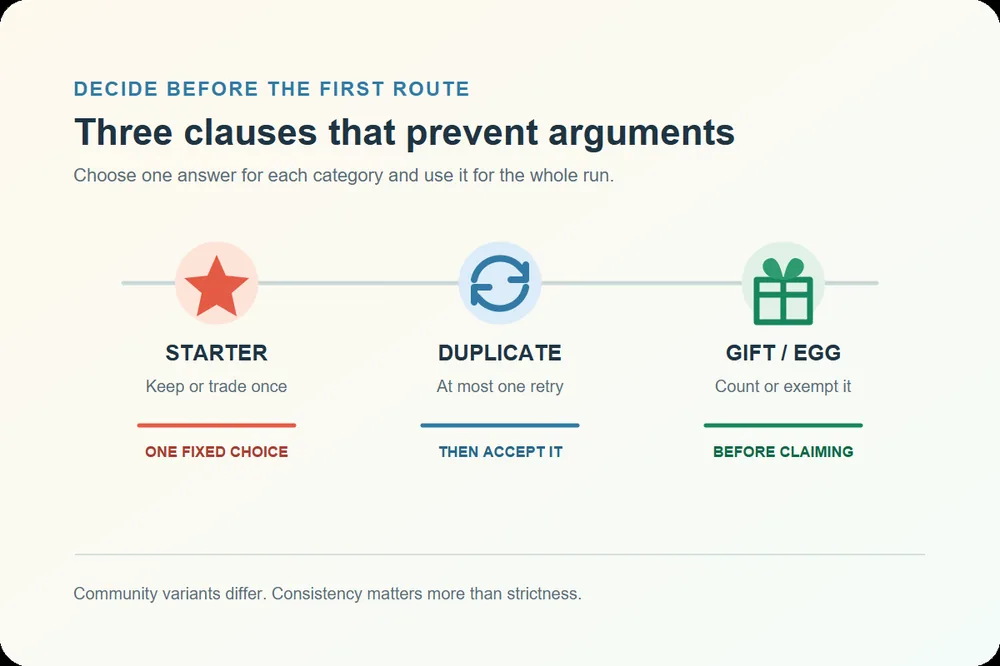
Most Wonderlocke variants differ on exceptions. A starter may be kept, counted as the opening encounter, or traded. Gifts, fossils, eggs, static encounters, and in-game trades may count toward a location or be exempt. Choose one policy for each before claiming them.
A practical beginner setup keeps the starter, counts only wild encounters toward the route limit, and allows one declared shiny exception. A stricter setup trades the starter and counts every gift or fixed encounter against a location. Either is fair if the rule is visible before the Pokemon appears. Avoid adding a special exception only after a rare or powerful result.
- Starter: keep it as the sole opening exception, or trade it once; do not change the choice later.
- Gift, egg, fossil, or static Pokemon: assign it to its displayed location or forbid it before collecting it.
- Shiny: decide whether it is a bonus, a replacement for the route encounter, or treated normally.
- Duplicate trade: choose one replacement at most, then accept the next result even if it repeats.
Keep a Simple Wonderlocke Run Log
Record the location, first encounter, received partner, and whether it is active, boxed, or retired. Share the log before major battles in a friend challenge or stream so everyone can check the same clauses.
If you make a mistake, correct the entry instead of quietly changing the rule. For example, if you accidentally trade twice, note the second trade and decide whether to keep the first valid result or restart that route according to your prewritten mistake policy. A transparent correction is fairer than retroactively selecting the more useful Pokemon.
- Location: Route 2 | First catch: Species A | Received: Species B | Status: Active.
- Location: Old Cave | First catch: Species C | Received: Species D | Status: Retired after fainting.
- Mark gifts or special cases with a short note so they do not look like extra route encounters.
Make the Challenge Easier or Harder Without Changing Its Core
For a relaxed first run, keep the starter, allow one duplicate replacement, and let boxed survivors return after a party wipe. Keep the first-encounter and random-trade rules; they define the challenge.
For a harder run, trade the starter, set a level cap, or limit healing. Add one restriction at a time so the challenge stays clear.
Community Rule Examples
These community pages show why Wonderlocke clauses vary. They are player-written examples, not official Pokemon rules or endorsements.
- PokeCommunity: The Wonderlocke Challenge — A player discussion describing a Wonderlocke-style challenge and its encounter and trade structure.
- Fait-y Wonderlocke Rules — A personal rule page illustrating variant decisions and optional clauses.
Pokemon Wonderlocke Rules FAQ
What are the basic Pokemon Wonderlocke rules?
Catch the first eligible wild Pokemon in each area, trade it once through a random trade feature, and use the received Pokemon as that area's encounter. Most players also add a fainting rule, but starters, gifts, duplicates, and party wipes vary by rule sheet.
Do you have to trade your starter in a Wonderlocke?
No universal rule requires it. Keeping the starter is an easy beginner exception; trading it once is a stricter variant. Decide before the first battle and keep that choice for the whole run.
What happens if a Wonderlocke Pokemon faints?
A common Nuzlocke-style rule retires the Pokemon permanently. Whether a full-party wipe ends the entire run or lets boxed survivors rebuild is a separate clause to settle before playing.
Can you reroll a duplicate Wonder Trade result?
Only if your written duplicate clause allows it. A fair limit is one replacement trade, followed by accepting the next valid result even if it is another duplicate.
Are Wonderlocke rules official?
No. Wonderlocke is a fan challenge, and player rule sheets differ. This article recommends one consistent template; it is not an official format from Nintendo, Game Freak, or The Pokemon Company.
Pick a Rule Set and Start the Run
Save your clauses before the first encounter, then use a random Pokemon pick when you need a neutral prompt for a team or side challenge.
Open Pokemon Roulette Read the Basic Nuzlocke Rules